


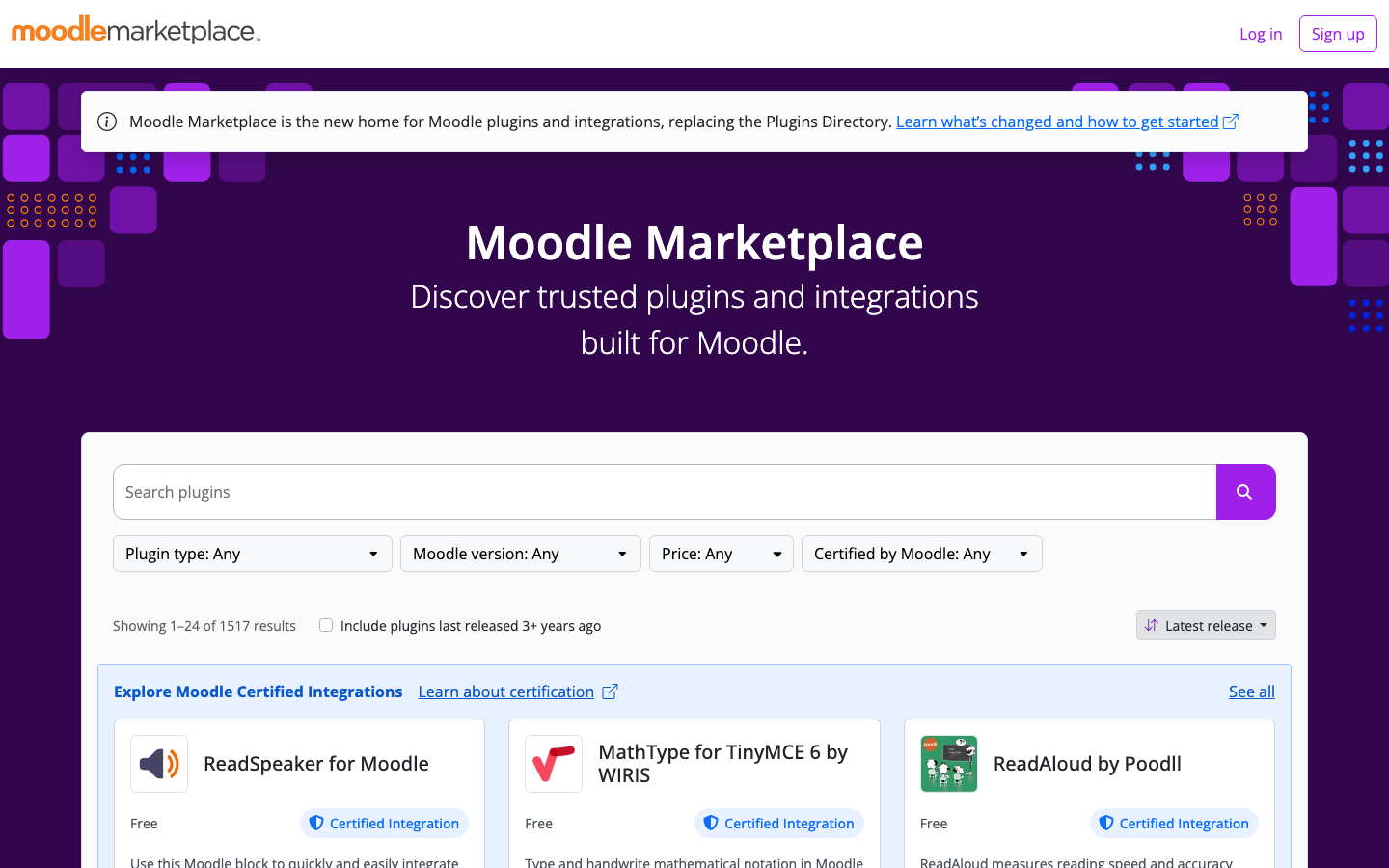
On 20 July 2026 Moodle officially launched the Moodle Marketplace, and with it closed a chapter that lasted fifteen years: the classic Plugins Directory. If you now visit moodle.org/plugins, you are redirected straight to the new marketplace. This is not a cosmetic redesign. It is a new platform with a new model — and for anyone who builds, buys, or maintains Moodle plugins, it changes how the ecosystem works.
"At Moodle, we're committed to building a learning ecosystem that can extend as your needs evolve — without replacing what's already working," said Moodle CEO Scott Anderberg in the launch announcement. "That's exactly what Moodle Marketplace is built to support."
The launch catalogue counts 1,517 listings, with version filters stretching from Moodle 1.9 all the way to 5.2, plus badge filters for Certified Integrations and Certified Partners.
What Is New for Users
The biggest improvement is discoverability. The marketplace introduces natural-language search: instead of guessing the exact technical name of a plugin, you can describe what you need. Under the hood, plugins that were updated recently or are maintained regularly are prioritised by default, so abandoned code sinks instead of cluttering the results.
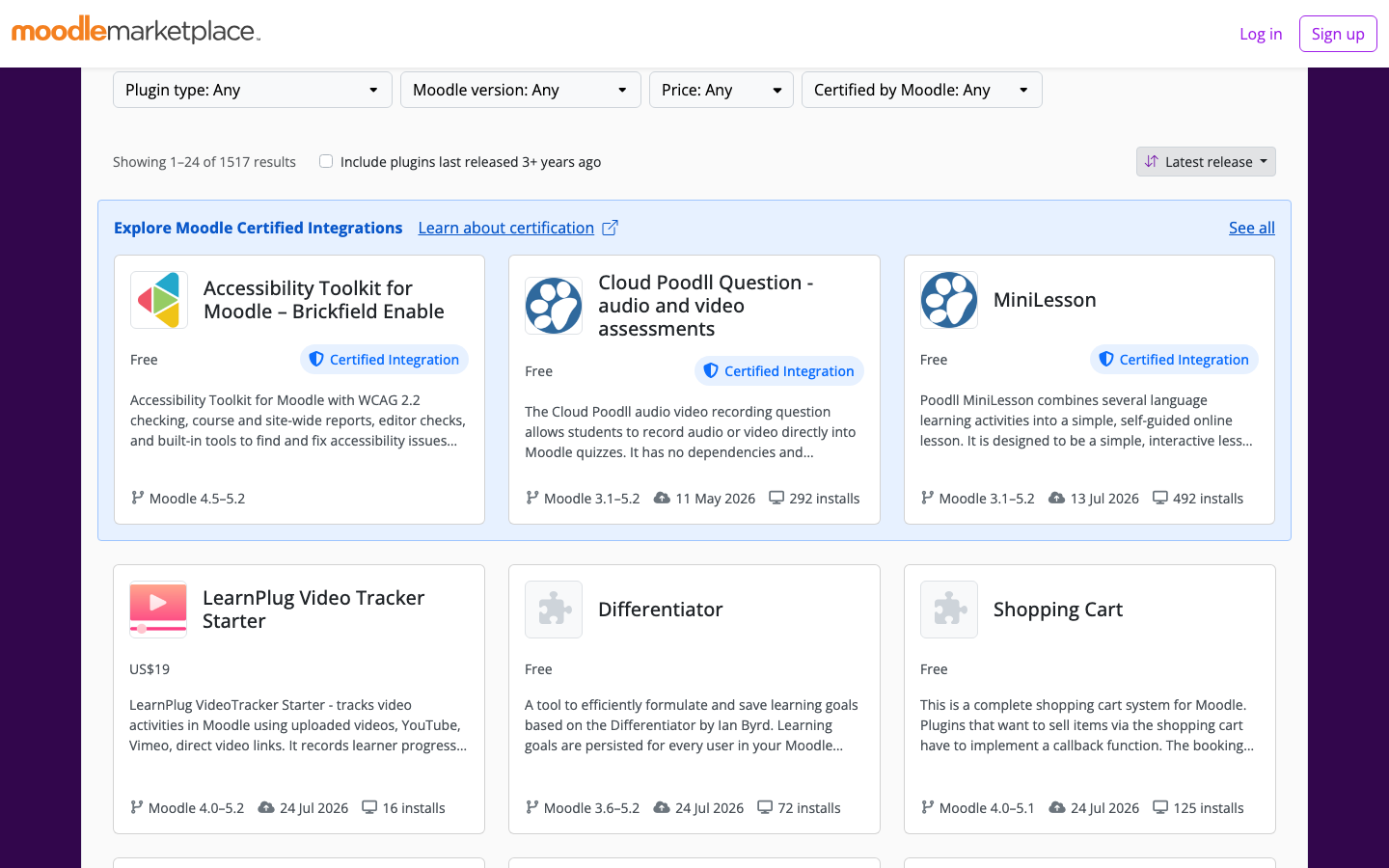
Plugin pages are now standardised. Every listing shows the same structured information — supported versions, maintenance status, and statistics — organised in tabs for Description, Support, Versions, Translations, and Stats. That consistency makes comparing two plugins for the same job far less painful than it used to be.
The second big change: free and paid plugins now live in one catalogue. You can install a free plugin or purchase a paid one without leaving the site, thanks to built-in e-commerce. Paid listings show their price options, a "Buy now" button, the seller's Terms of Sale, and a "Reviewed annually for quality" label.
One detail we particularly like: plugins last released three or more years ago are hidden by default. There is a toggle to include them, but out of the box the catalogue favours living software. For a community where adopting an unmaintained plugin is the classic pitfall, that matters.
What Is New for Developers
For plugin developers, the marketplace opens something the directory never offered: a direct channel to sell their work. Paid plugins go through an internal review by Moodle HQ and are re-reviewed annually. From agencies that went through the process, we know a Privacy API provider is mandatory and automated tests are expected for paid plugins — which raises the bar for everyone, in a good way.
On the commercial side, sellers can offer fixed annual pricing, monthly subscriptions, or tiered models, with prices in USD and payouts handled via Stripe Connect. Moodle has not published an official revenue-share figure, so we will not speculate on one.
As Moodle's Chief Product Officer Marie Achour put it: "Moodle Marketplace is about supporting that spirit — connecting organisations with solutions, helping developers showcase their work, and making it easier for everyone to benefit from the strength of the Moodle ecosystem."
From a Forum Database to a Marketplace: 20 Years of Moodle Plugins
The road here is worth remembering:
- 2006 — the first 'Modules and plugins' and 'Themes' databases appear on moodle.org, little more than structured community listings.
- October 2011 — the new Plugins directory launches at moodle.org/plugins, with approval through automated checks plus peer review by volunteer 'Plugins guardians'.
- December 2022 — the directory passes 2,000 open-source plugins contributed by 1,147 developers. Along the way it introduces awards the community learned to trust: 'Early bird' badges per release, 'Automated testing support' (around since at least 2015), and 'Privacy friendly' (since the GDPR Privacy API landed in Moodle 3.5 in 2018).
- June 2025 — the marketplace is first publicly revealed in the run-up to MoodleMoot Global.
- September 2025 — at MoodleMoot Global in Edinburgh, Moodle HQ confirms the directory "will be replaced by a full-featured e-commerce and revenue-share marketplace".
- 26 February 2026 — developers are invited to submit paid plugins; the old directory goes read-only.
- 20 July 2026 — the Moodle Marketplace officially launches.
Our Own Small Place in It
We will be honest: we are biased, and happily so. Our plugin Information Banner is among the very first paid listings on the marketplace — plugin ID 53, no less. The Premium plan is $49 USD per year, supports Moodle 4.5 through 5.2, and carries both the Privacy friendly and Automated testing support awards we wrote about when the plugin first launched.
You can find it here: Information Banner on the Moodle Marketplace.
Information Banner puts scheduled, site-wide announcements at the top of every page — dismissable per user, capability-controlled, and fully GDPR-compliant. Seeing it sit in the very first wave of paid plugins, next to vendors many times our size, is a milestone for our small Dutch team.
What This Means for Your Moodle Site
If you administer a Moodle site, the practical takeaway is simple: the marketplace is now the place to look, and its defaults — maintained-first ranking, stale plugins hidden, standardised pages — make it safer to browse than the directory ever was. If a plugin you rely on has not made the move yet, that is worth a conversation with its maintainer.
And if you need something that does not exist in a catalogue of 1,517 listings — a custom plugin, an integration, or help choosing and combining the right tools — that is exactly what we do all day at Ldesign Media. Get in touch; we would love to hear about it.