

"What does an LMS cost?" is the question we hear most often from L&D managers, HR teams, and trainers who are comparing learning platforms. The honest answer: anywhere from a few hundred euros per year to well over a hundred thousand, depending on the route you choose. In this guide we break down the three main routes (a commercial SaaS LMS, a professionally managed open-source LMS, and custom development), the cost drivers that really move the number, the costs that are easily missed in a first price comparison, and what a realistic total cost of ownership looks like over three to five years.
All figures in this article are indicative ranges based on what we see in the Dutch and Belgian market. Prices vary per vendor, contract, and situation, so treat them as orientation, not as a quote.
1. The Short Answer: Three Routes
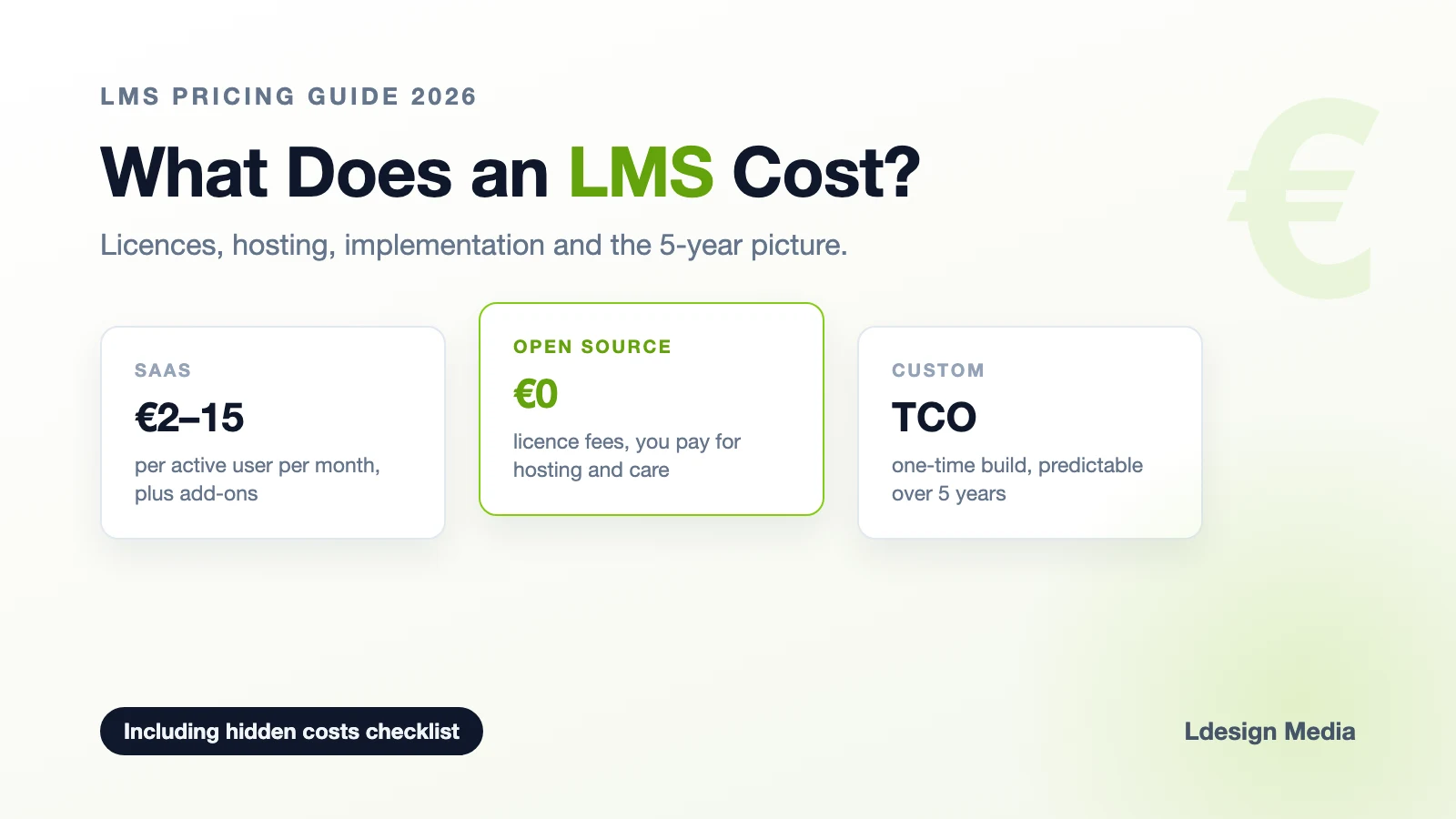
In practice, organizations usually choose between three routes: a commercial SaaS LMS, a professionally managed open-source LMS, or a largely custom-built learning environment. These routes can partly overlap, but they have clearly different cost structures.
SaaS LMS: per-user license fees
With a commercial SaaS platform you pay a recurring license fee, usually per active user per month. Indicatively, in the Dutch market we see rates of roughly €2 to €15 per active user per month. Some vendors, however, work with flat subscriptions, user bundles, or enterprise contracts instead of a per-user price. Based on quotes and projects we encounter in the Dutch and Belgian market, we roughly see the following ranges:
- Entry-level packages: roughly 2 to 5 euros per user per month, often with a minimum of 50 to 100 users
- Mid-market platforms: roughly 5 to 15 euros per user per month, usually with annual platform fees on top
- Enterprise suites: 15 euros and up per user per month, with implementation fees that can run into the tens of thousands
For 500 users at a mid-market rate, you are quickly looking at 30,000 to 90,000 euros in license costs per year, excluding implementation, support, and add-ons. Every year, for as long as you use the platform.
Open source (Moodle): no license costs
Moodle is open source, released under the GNU GPL license and free to download from moodle.org. There are no license fees per user. Moodle imposes no user limit in the software itself; practical limits are set by hosting and infrastructure. There are no per-user software licences that are re-billed every year. An LMS without license costs does not mean an LMS without costs: you pay for hosting, implementation, maintenance, and optionally support. But the cost structure is fundamentally different. Your budget mainly goes toward implementation, infrastructure, management, and further development, instead of recurring per-user software licenses.
Custom development (maatwerk)
With custom development you invest in a learning environment built around your processes, usually on an open-source foundation like Moodle. A focused custom plugin starts at a few thousand euros; a complete custom environment with theme, integrations, and plugins typically ranges from 25,000 to 100,000+ euros as a one-time investment. After that, your running costs are hosting and a support agreement.
SaaS vs Open Source vs Custom at a Glance
- License costs: SaaS: per user per month, re-billed every year | Open source: no license fees | Custom: no license fees, but one-time development costs
- User limit: SaaS: costs grow with every user | Open source: no limit in the software; practical limits set by hosting and infrastructure | Custom: same, tailored to your infrastructure
- Upfront costs: SaaS: low, often with onboarding and implementation fees | Open source: implementation, theme, and configuration | Custom: highest initial investment
- Costs as you grow: SaaS: a license bill that grows with you | Open source: mostly extra hosting capacity | Custom: mostly hosting and further development
- Flexibility and integrations: SaaS: limited to what the vendor offers | Open source: fully extensible with plugins | Custom: fully bespoke, including integrations with your systems
- Data and exit: SaaS: subject to the vendor's export options and exit terms | Open source and custom: generally more control over data, hosting, and export, depending on the chosen management and contract model
2. The Real Cost Drivers
The sticker price of an LMS is determined less by the vendor and more by five drivers. Understanding them puts you in control of any LMS quote (lms offerte) you receive.
Number of users
The dominant variable for SaaS platforms. Watch out for how "user" is defined: registered users, monthly active users, or concurrent users each produce very different bills. With open source, the user count mainly affects hosting capacity, not license costs.
Integrations
Connecting your LMS to your HR system, SSO (Azure AD, SAML), CRM, or payment provider can account for a significant share of the implementation budget and, in complex projects, raise total costs sharply. Off-the-shelf connectors can be sufficient when both systems support the same standards and data structures. Integrations with organization-specific processes, data models, or exceptions often require additional configuration or custom development.
Hosting
SaaS hosting is bundled into your license. For open source you choose: professional managed hosting often starts around 100 euros per month and can run up to several thousand euros per month for business-critical environments with high availability.
Support and maintenance
As a general software rule of thumb, the annual cost of technical maintenance, security updates, and limited ongoing development is often budgeted at roughly 15 to 25 percent of the original technical implementation cost. Deferring maintenance for a long time can lead to higher upgrade, security, and recovery costs.
Content
The platform is only the container. Creating e-learning content (instructional design, video, interactive modules) is a cost driver of its own. For organizations that need to develop many new courses, the content budget can ultimately exceed the technical LMS budget. Off-the-shelf course libraries cost 5 to 30 euros per user per course; custom-made e-learning ranges from 5,000 to 25,000 euros per finished hour of learning, depending on interactivity. Simple content can be considerably cheaper; video, animation, simulations, and complex interactions can raise the cost sharply.
3. Costs That Are Easily Missed in a First Price Comparison
In 15+ years of Moodle projects, we have seen the same surprises come back in almost every LMS budget discussion:
- Onboarding and implementation fees: many SaaS vendors charge 5,000 to 25,000 euros one-time before you can start
- Price per user at renewal: contracts that looked sharp for 200 users become painful at 800
- Premium features: reporting, API access, SSO, and white-labeling often sit in a higher tier
- Data export and migration: some vendors charge for data export or professional migration assistance, and the completeness, format, and cost of an export vary per vendor
- Unused seats: licenses for employees who never log in
- Content lock-in: content from a vendor-specific authoring tool is not always transferable as an editable source file; sometimes you can only export the published output
4. TCO: What an LMS Really Costs Over 3 to 5 Years
License fees are only one line in the total cost of ownership. A realistic comparison for an organization with 500 users, roughly and depending on size and complexity:
SaaS mid-market platform (5 years):
- Licenses: 150,000 to 450,000 euros (500 users × €5 to €15 × 60 months)
- Implementation and onboarding: 10,000 to 30,000 euros
- Integrations: 10,000 to 40,000 euros
- Management, support, and annual indexation: 10,000 to 40,000 euros
- Total: roughly 180,000 to 560,000 euros, depending on size and complexity
Open source Moodle, professionally managed (5 years):
- Licenses: 0 euros
- Implementation, theme, and configuration: 15,000 to 50,000 euros
- Hosting: 6,000 to 30,000 euros
- Support, updates, and small improvements: 25,000 to 75,000 euros
- Upgrades, monitoring, and data migration: 5,000 to 25,000 euros
- Total: roughly 51,000 to 180,000 euros, depending on size and complexity
Custom LMS development on Moodle (5 years):
- One-time development: 25,000 to 100,000+ euros
- Hosting, support, and further development: 40,000 to 100,000 euros
- Upgrades, monitoring, and data migration: 5,000 to 25,000 euros
- Total: roughly 70,000 to 225,000 euros, depending on size and complexity, with an environment that fits your processes exactly
A complex implementation with many integrations or specific requirements can exceed these ranges; for large custom projects the TCO can also run above 250,000 euros.
This comparison covers the main external platform costs, but not the internal hours for functional administration, content management, training, and change management. Those costs can be significant for all models.
The pattern is consistent: with SaaS models that charge per user, costs grow with the number of registered or active users, while with open source and custom development the investment is front-loaded and the marginal cost per extra user is usually limited, because no per-user license is charged. That is where organizations save on LMS license costs most. Our TCO calculator lets you run this comparison with your own numbers.
5. When Does an Open-Source or Custom LMS Become More Attractive Than SaaS?
SaaS is a rational choice when you have a small, stable user group, standard requirements, and no integration needs. A professionally managed open-source LMS, optionally extended with custom development, becomes especially attractive when:
- You have more than a few hundred users and per-user pricing makes growth expensive
- You need integrations with HR, SSO, planning, or payment systems
- You have specific requirements around data location, processors, retention periods, and data access due to GDPR, information security, or internal policy
- You want your own branding and UX without vendor constraints
- You need workflows that no standard platform supports
For organizations such as KLM and Nedap, we developed Moodle functionality that aligned with organization-specific training processes.
6. Requesting an LMS Quote: What a Good Quote Contains
When you request a quote for a learning platform (leerplatform offerte), compare more than the bottom line. A serious LMS quote specifies:
- Which cost model applies and how users are counted
- What is included in implementation (data migration, theme, configuration)
- Which integrations are included and which are billed hourly
- The hosting arrangement and where your data is stored
- The support scope: response times, updates, upgrade policy
- Exit terms: can you export your data and content, and at what cost
If a quote only shows a per-user price, ask for the five-year total. That is the number that matters.
7. Frequently Asked Questions
What does Moodle itself cost?
Moodle is free to download and use. For Moodle LMS itself you pay no license fees per user, regardless of the number of users. Hosting, implementation, management, and any commercial plugins or additional services do cost money. Read more on our LMS development service page.
What does it cost to have an e-learning platform built?
A focused custom plugin starts at a few thousand euros. A complete custom learning environment with integrations typically starts around 25,000 euros, depending on scope. The ranges above are indicative; every project is scoped individually.
Is an LMS without license costs really cheaper?
For organizations with a few hundred users or more, a professionally managed open-source LMS proves financially more attractive than a per-user SaaS model in many situations over multiple years. The exact break-even point, however, differs per situation. Below that, SaaS entry packages can be competitive, until you need integrations or grow.
Can we keep our existing content when switching?
Often yes, but it depends on the format used and the available source files. SCORM packages can generally be moved to another SCORM-compliant LMS. For all other content, we look at the options together: which exports does the current platform offer, is there an API available, and can progress, results, and certificates come along? We can map this out in a quickscan of your current environment. Content from a vendor-specific authoring tool is not always transferable as an editable source file; sometimes only the published output can be exported.
Conclusion
The right question is not "what does an LMS cost" but "what will our LMS cost us over five years, including everything." For organizations with a few hundred users or more, a professionally managed open-source platform can be more cost-effective over multiple years, particularly when the SaaS alternative is billed per user. This must be calculated per situation, including implementation, management, upgrades, internal hours, and exit costs.
Want to know what this looks like with your numbers? Run the comparison in our TCO calculator, request a free Moodle quickscan of your current environment, or get in touch for a no-obligation conversation. Ldesign Media has been active with Moodle since 2010 and has delivered more than 300 custom plugins, so chances are we have solved your challenge before.