

A white label learning platform lets you offer online training completely under your own brand: your logo, your colours, your domain, your tone of voice, with no trace of the vendor behind it. For training providers, trainers, industry associations and agencies that resell courses, that brand control is not a luxury but a core business requirement. In this guide we explain what white label really means for learning platforms, who it serves, what your options are, and which pitfalls to avoid.
At Ldesign Media we build white label learning environments on Moodle for organizations that sell training or run academies under their own brand. This is what we have learned from 15+ years of doing exactly that.
1. What Does White Label Mean for a Learning Platform?
White label originally comes from manufacturing: one producer makes the product, another company sells it under its own brand. For a learning platform it means the technology behind your academy is invisible to your learners and customers:
- The platform runs on your domain (academy.yourbrand.com), not on a vendor subdomain
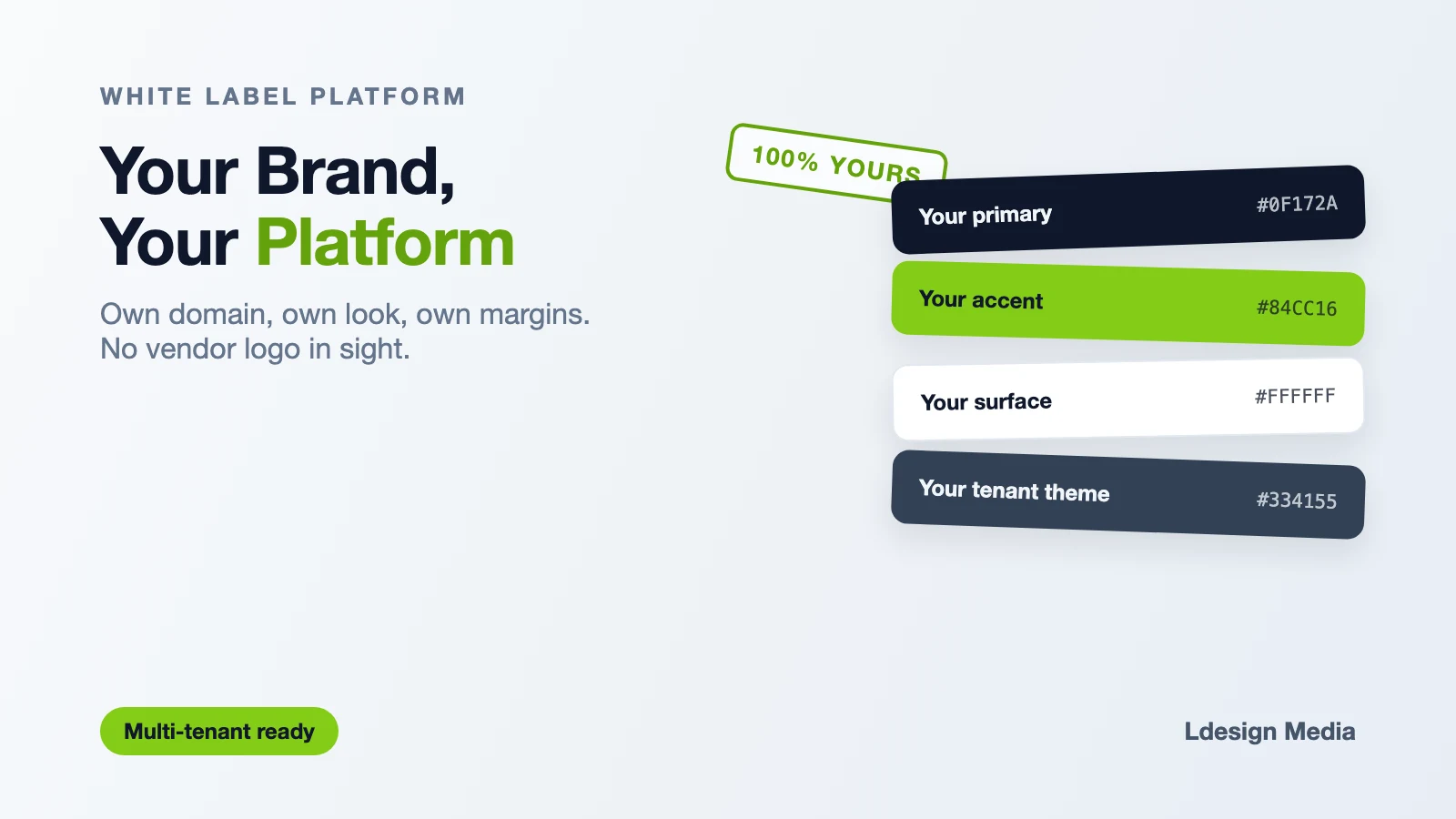
- The interface carries your corporate identity: logo, colours, typography, imagery
- Certificates, emails and notifications come from your brand
- There is no "powered by" badge, no vendor logo in the footer, no vendor URL in the address bar
That last point is where many SaaS tools quietly fail. More on that in the pitfalls section.
2. Who Needs a White Label Learning Platform?
Training providers and trainers
If you sell courses, the platform is your storefront. Customers who pay for your expertise should experience your brand from the first login to the final certificate. A visible third-party tool undermines the premium positioning you charge for.
Industry associations and sector organizations
Industry associations that offer certified training to members need an academy that members recognize as theirs, with certificates that carry the association's authority, not a software vendor's name.
Agencies and resellers
Marketing agencies, consultancies and e-learning studios that resell training to their clients need something stronger still: a platform where each of their clients gets a branded environment, managed centrally. That requires multi-tenancy, which we cover below.
Corporates that want full brand control
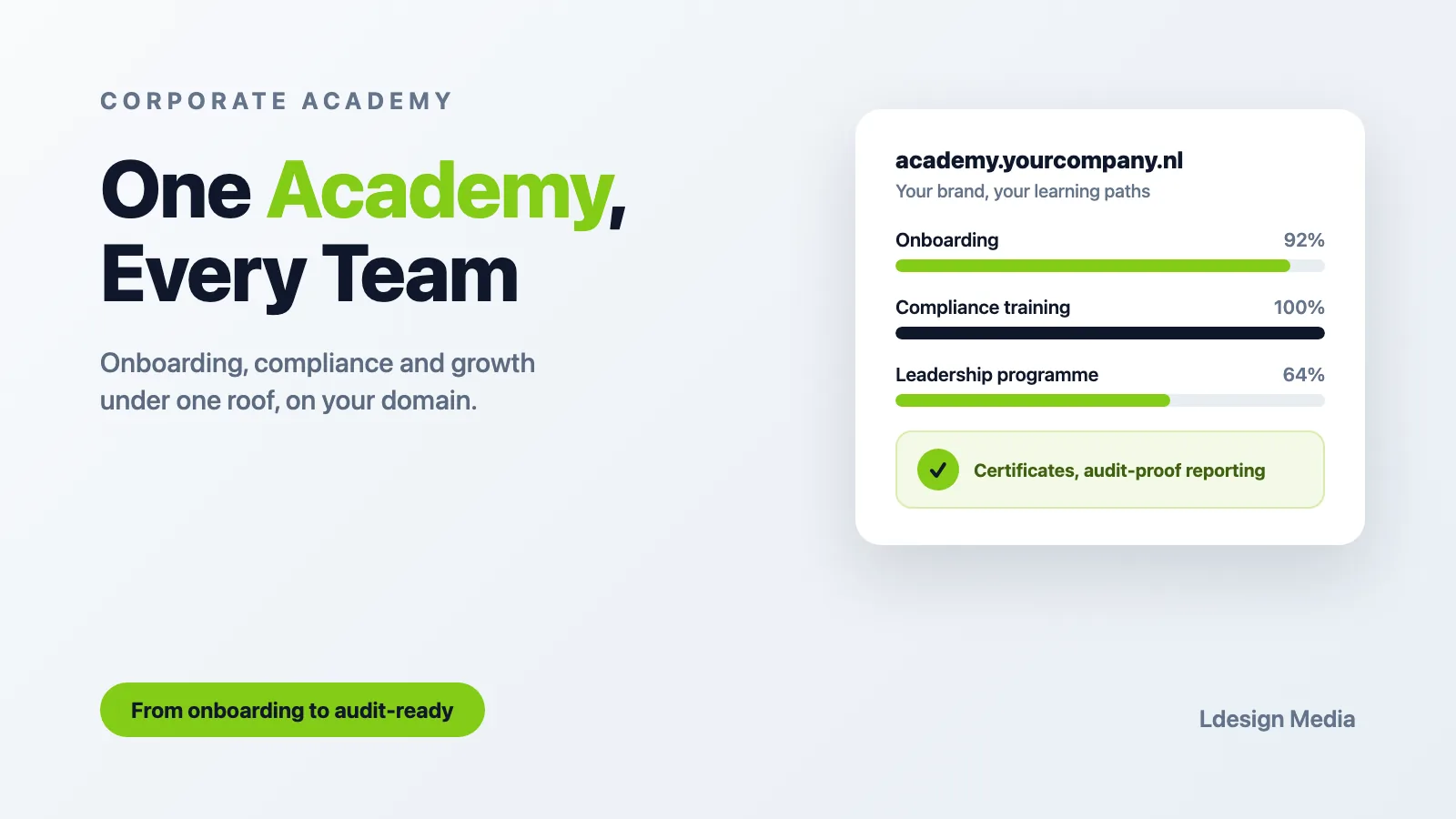
Even for internal academies, branding matters. An onboarding platform in the company's own look and feel, on its own domain, feels like part of the organization instead of another external tool. If you are weighing that scenario, our corporate academy service covers the full process.
3. The Options Spectrum: From Logo Swap to Fully Custom
"White label" is a marketing term that covers very different realities. Broadly there are three levels.
Level 1: SaaS with a logo swap
Most commercial LMS vendors offer a white label tier: upload your logo, pick your accent colour, maybe map a custom domain. Fast to set up, but the limits show quickly:
- The theme options stop at colours and a logo; the layout and interaction patterns stay the vendor's
- Custom domains are often restricted to higher pricing tiers
- URLs, mobile apps, login pages or email templates still reveal the vendor in places
- Per-user pricing keeps growing with your success
Level 2: SaaS with deeper theming
Some platforms allow custom CSS and page builders. Better, but you are still theming inside someone else's product, renting your storefront by the month, per user.
Level 3: Fully custom-branded open source Moodle
With open source Moodle there is no vendor brand to hide in the first place. You own the platform, so white label is the default state, not an enterprise add-on:
- Your own theme, designed and built in your corporate identity, down to the last pixel
- Your own domain and hosting, with data stored where you choose (EU hosting for GDPR)
- Your own mobile app: a branded Moodle app or a fully custom app in the app stores under your name
- Unlimited customization: plugins, workflows, enrolment logic and integrations built for your business model
- No licence fees per user: you pay for building and hosting, not for growth
The trade-off is that you need a partner to build and maintain it. For organizations whose training is a revenue stream rather than a cost center, that investment behaves like any other business asset.
4. Multi-Tenancy: Selling Courses to Multiple Client Organizations
The most powerful white label pattern is multi-tenancy: one platform, many branded sub-academies. Each tenant, whether a department, a franchise or a paying client organization, gets:
- Its own subdomain or domain, logo and colour scheme
- Its own course catalogue, users and managers
- Its own certificates and email branding
- Full separation of data and reporting
Multi-tenancy is not part of standard Moodle, but it is exactly the kind of custom development we build: tenant provisioning, per-tenant payment flows and automated onboarding of new client organizations. A training provider can onboard a new corporate customer by creating a tenant, not by installing a new platform.
This structure also future-proofs internal academies: an employee academy can later open selected tenants for customers, partners or resellers without rebuilding anything.
5. Monetization: Turning the Platform Into a Revenue Stream
For commercial training businesses the platform must handle money as naturally as it handles courses. A custom Moodle setup supports the full commercial stack:
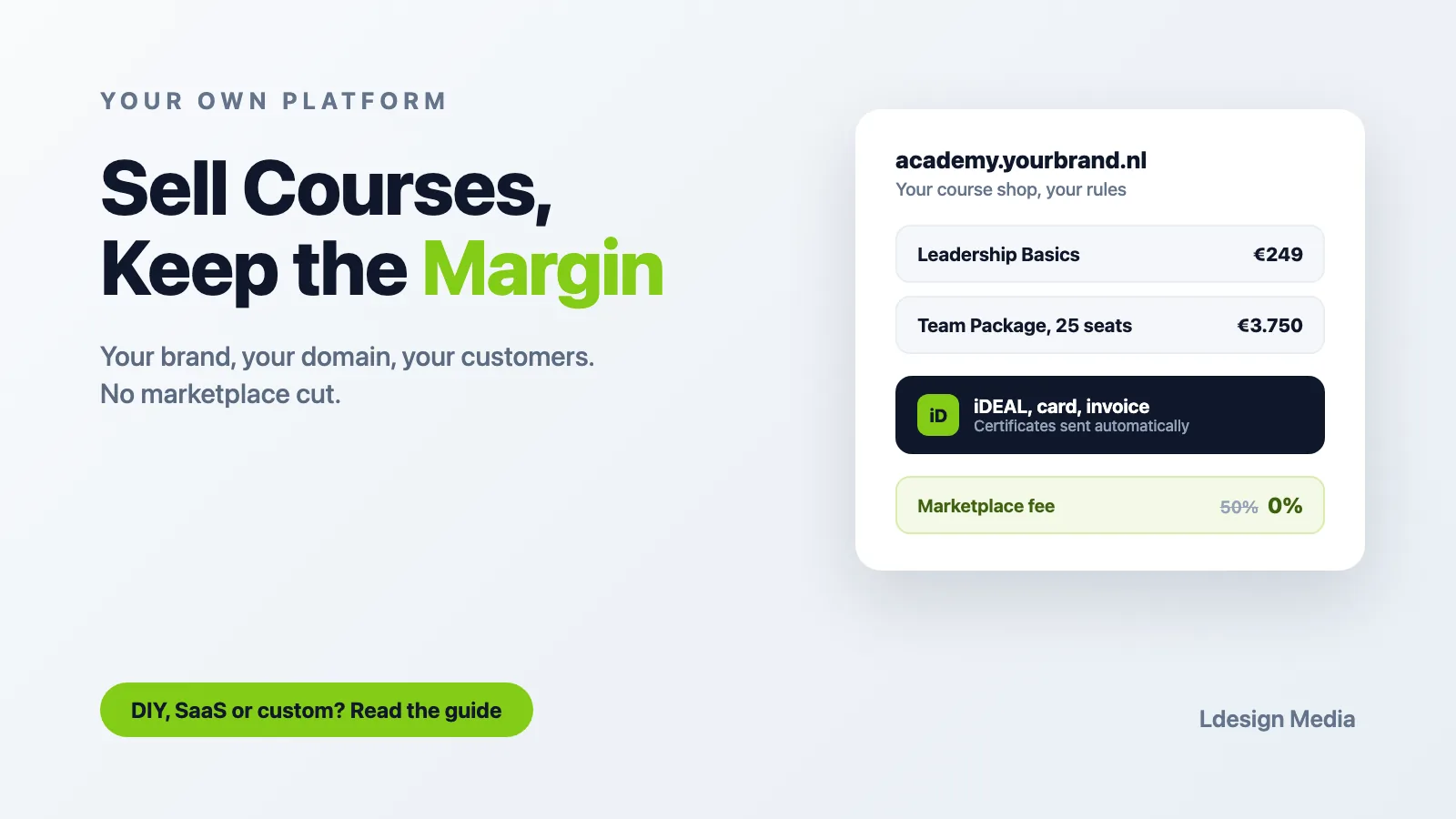
- Course sales per seat or per group: individual checkout, or bulk enrolment where a client organization buys seats for its employees
- Payment integration: iDEAL, credit card, SEPA and invoicing through processors like Mollie or Stripe
- Self-service purchasing: a client admin buys 50 seats and assigns them to colleagues without touching your back office
- Subscriptions and bundles: recurring access to a catalogue instead of one-off course sales
- Per-tenant pricing: different catalogues and price lists per client organization
Because there are no per-user platform fees, your margin per sold seat stays yours. With SaaS platforms, every new customer you win also increases your platform bill, sometimes dramatically.
6. Pitfalls to Avoid
"White label" that still shows the vendor
Before signing with a SaaS vendor, check every learner touchpoint: the login page, the URL, password reset emails, certificate PDFs, the mobile app listing, the help widget, the page footer. If any of them carry the vendor's brand, your customers will find it. Ask for a demo tenant and click through the entire journey.
Per-user fees eating your margins
A platform fee of €5-15 per user per month sounds reasonable at 100 learners. At 5,000 learners across 40 client organizations it becomes your largest cost line. Run the five-year numbers before committing, especially if selling training is your business model.
Migrating content later is painful
SCORM packages migrate reasonably; interactive content built in a vendor's proprietary authoring tool often does not. If portability matters, favour platforms and formats you can take with you.
Underestimating maintenance
An owned platform needs updates, security patches and hosting. Budget for managed hosting or a support contract, and treat it like any other business-critical system. The freedom of open source comes with the responsibility of ownership, which a good partner largely takes off your hands.
7. How to Decide
Ask yourself three questions:
- Is training a revenue stream or an internal cost? Revenue streams justify owning the platform.
- How many learners and client organizations will you serve in three years? Multiply by the per-user SaaS fee and compare with a custom build.
- How important is complete brand control? If your brand is what customers pay for, a logo swap is not enough.
If you sell training, serve multiple client organizations, or simply refuse to rent your own storefront, a custom-branded Moodle platform is almost always the stronger long-term choice.
Conclusion
A white label learning platform is about owning the learner experience end to end: domain, design, data and margin. SaaS tools offer a quick start with hidden brand and cost ceilings. A custom-branded Moodle environment, optionally with custom-built multi-tenant structures, gives training providers, associations and resellers full control without per-user licence fees.
At Ldesign Media we design and build white label learning environments on Moodle: your brand, your domain, multi-tenant structures for your clients, and payment integrations that turn courses into revenue. Curious what that looks like for your organization? Get in touch for a no-obligation consultation.